
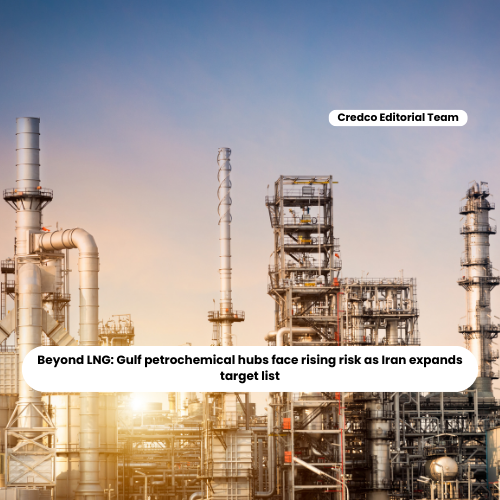
Iran stated that energy facilities in Saudi Arabia, the UAE and Qatar have become “direct and legitimate targets” following recent attacks. The sites identified include Ras Laffan refinery and Mesaieed petrochemical complex in Qatar, Samref refinery and Jubail petrochemical complex in Saudi Arabia, and the Al Hosn gas asset in the UAE—many of which involve US-linked interests.
Ras Laffan: More than an LNG hub
At the center of Qatar’s petrochemical network, Ras Laffan Industrial City plays a critical upstream role. The site, where significant refinery damage has been reported, hosts an ethane cracker with a capacity of around 1.3 million tons per year, supplying feedstock to downstream units in Mesaieed via pipeline.
Additionally, a major new complex under construction is expected to add approximately 2.0–2.1 million tons per year of ethylene capacity along with about 1.7 million tons per year of polyethylene. Once completed, it is set to become the largest ethane-based cracker in the Middle East, reinforcing Ras Laffan’s importance beyond LNG into the broader petrochemical value chain.
Mesaieed: Key downstream derivatives hub
Further along the chain, the Mesaieed complex serves as a major derivatives center. It hosts around 600,000 tons per year of ethylene, nearly 1.4 million tons per year of polyethylene, and about 350,000 tons per year of PVC. This makes it a crucial outlet for ethylene derivatives, meaning any disruption at Ras Laffan could quickly impact polymer markets.
Jubail: Scale of global significance
Regional exposure increases significantly with Saudi Arabia’s Jubail industrial complex, one of the largest integrated petrochemical hubs in the world. The site includes roughly 16 million tons per year of ethylene capacity, 6.5–7 million tons of propylene, 4.5–5 million tons of polypropylene, and around 9 million tons of polyethylene across grades.
These figures highlight the scale of operations, with Jubail alone comparable to entire regional markets due to its highly integrated production chains.
Systemic risk across interconnected hubs
Together, Ras Laffan, Mesaieed and Jubail form a tightly linked petrochemical corridor—spanning upstream feedstocks, downstream derivatives, and fully integrated olefins and polyolefins production. Any prolonged disruption in one part of this system is likely to ripple across the entire chain, affecting global trade flows in petrochemicals.
Meanwhile, Saudi Arabia’s Aramco has resumed operations after a temporary refinery shutdown earlier this month, with no major downstream plant outages reported so far.
Ruwais adds to regional vulnerability
In the UAE, ADNOC has already halted operations at the Ruwais refinery as a precaution after a drone strike caused a fire in the surrounding industrial zone on March 10. The Ruwais complex is a key downstream hub, producing fuels such as gasoline, diesel and jet fuel, much of which is exported.
The site also hosts major petrochemical operations, including facilities linked to Borouge. Ruwais has an estimated capacity of 3.5–4 million tons per year of ethylene, around 5 million tons of polyethylene, over 2 million tons of polypropylene, and nearly 2 million tons of propylene, with further expansions underway.
The widening scope of risks across these interconnected hubs underscores that the impact extends far beyond LNG, posing a broader threat to global petrochemical supply chains.
Stay ahead of market trends with the Credco app. For any queries, please reach out via WhatsApp at +91 8448083211.